
Porterville City Directory Shelf
The exact local inventory comes from the City of Tulare's genealogy-room document. It shows a Porterville city directory shelf with dedicated volumes, regional books, and county series. The holdings are in the Hillman Family Library of Local History and Genealogy at Tulare Public Library. Access is in-room, with staff or Sequoia Genealogical Society volunteers available for research questions. No open scan of a Porterville alphabetical page or abbreviation key was located, so inspect the front matter of the chosen volume.
| Collection | Years | Where held | Access and scope |
|---|---|---|---|
| Porterville City directory | 1948 | Porterville shelf, Tulare genealogy room | In-room; ask staff or SGS volunteer |
| Porterville directory | 1958 | Porterville shelf, Tulare genealogy room | In-room |
| R. L. Polk Porterville City | 1959, 1963, 1965 | Porterville shelf, Tulare genealogy room | Includes Lindsay, Strathmore, Terra Bella, Woodville |
| R. L. Polk Porterville-Lindsay | 1971, 1973, 1974 to 1979 | Porterville shelf, Tulare genealogy room | Earlier run includes Poplar, Strathmore, Woodville |
| R. L. Polk Porterville-Lindsay | 1981 to 1989, 1991 | Porterville shelf, Tulare genealogy room | Listed as including Strathmore and Terra Bella |
| Tulare County Business | 1888 | Porterville research shelf, Tulare genealogy room | County business evidence before dedicated city runs |
| Tulare County Business/Resident | 1904 to 1905 | Porterville research shelf, Tulare genealogy room | County resident and business entries |
| Regional telephone directory | 1908 to 1909 | Porterville research shelf, Tulare genealogy room | Six-county coverage; check the locality |
| Polk's Tulare County | 1934 to 1958, with gaps | Porterville research shelf, Tulare genealogy room | Check Porterville inclusion volume by volume |
Note: A Porterville directory cover can include nearby Porterville-area communities, so copy the locality heading from the entry.
Polk Porterville Reached Nearby Towns
The phrase “Porterville” on a Porterville directory cover does not always mean only incorporated blocks. The 1959, 1963, and 1965 R. L. Polk Porterville City volumes include Lindsay, Strathmore, Terra Bella, and Woodville. Earlier Porterville-Lindsay volumes include Poplar, Strathmore, and Woodville. The later 1981 to 1991 holdings are listed with Strathmore and Terra Bella. That changing Porterville footprint is a useful geographic clue when a surname appears under a community that seems outside the question.
Porterville sits below the Sierra Nevada foothills at the eastern edge of the San Joaquin Valley. Agriculture, citrus, livestock, packing, transport, and rural routes made a Porterville regional directory more useful than a strict city boundary. Record the Porterville book title, year, locality heading, street, and occupation together. A shared regional volume suggests coverage, not a family relationship or a current address.
The Porterville Historical Museum and Jeff Edwards Archives offer a second local-history route for photographs, subject files, organizations, and street clues. Its online material does not publish a complete directory inventory, so ask for a surname, organization, or street finding-aid check before relying on a visit.
The Porterville museum image belongs with the regional coverage story because local archives can connect a directory name to a Porterville photograph or subject file without pretending that the archive is a current resident list.
County Directories Before 1948
Dedicated Porterville city directory runs do not begin the local trail. The Porterville genealogy room holds a Tulare County Business volume from 1888, a Tulare County Business/Resident set from 1904 to 1905, and a broad regional telephone directory from 1908 to 1909. Polk's Tulare County volumes cover many years from 1934 through 1958, with gaps. These sources can place a person in a Porterville business, residence, or county locality before the dedicated Porterville books become consistent.
Early Porterville county volumes need more locality control than a city title. A name may sit in a county section, a business listing, or a regional telephone segment. Check the Porterville index, street section, publisher's scope, and page heading. If the entry supplies only a business name, connect it to a person through a deed, newspaper, business filing, or probate record rather than calling it a home address.
| Era | Useful companion evidence |
|---|---|
| 1888 | County business names and early commercial geography. |
| 1904 to 1905 | County business and resident entries. |
| 1908 to 1909 | Regional telephone coverage across six counties. |
| 1934 to 1958 | Polk county series, checked one volume at a time. |
Porterville Sanborn maps, county deeds, the federal census, and newspapers can fill a gap without changing what the directory actually says. The oldest Porterville evidence is often a cluster of partial clues, not a clean annual run.
Reading Porterville Directory Entries
A Porterville city directory entry should be copied before it is interpreted. Start with the Porterville title page, publisher, year, coverage statement, and abbreviation key. Then capture the surname, given name or initial, spouse notation, widow designation if present, occupation, business affiliation, residential address, phone, business address, and any occupancy mark. The research file did not provide an authoritative open scan of a Porterville page, so standard Polk conventions must be verified in the selected Porterville book.
“Index” means a finding aid. “Image” means the scanned or photographed page. A Porterville criss-cross section reverses the usual direction and may list a street, number, householder, and phone. A Porterville householder index can point to the person treated as the address's main entry, not every person in the building. These distinctions keep a city directory useful without making it say more than the page supports.
- Copy the Porterville name exactly, including initials, accents, particles, and punctuation.
- Record the Porterville street number and locality heading, not only the town name.
- Write down Porterville occupation and employer as a period clue, not as proof of identity.
- Check the Porterville abbreviation key before expanding a mark or status.
- Photograph the Porterville title and key with the entry so a later reader has context.
- Criss-cross directory
- A reverse Porterville section that starts with an address and works toward a householder.
- Abbreviation key
- The publisher's explanation of short marks for occupation, status, or address.
- Householder
- The person the volume treats as the primary entry for an address, not necessarily every occupant.
Porterville Reverse Directory Sections
Reverse or criss-cross sections are the bridge from an old Porterville street to a name. They are especially useful when a surname changed, an address is remembered but a name is not, or a family appears in a neighbor's entry. Their presence is volume dependent. The official inventory lists Porterville years and holdings, but it does not certify a reverse section in every issue.
Check the Porterville street name, address order, and any geographic subdivision. A blank reverse page can mean that the issue has no section, that the street fell outside the canvass, or that the address was recorded under a nearby community. Compare the same Porterville street in the prior and next available volume. If the result changes, use APN, deed, map, or census evidence to test the change.
For present parcel work, use the Porterville street directory by address page instead. The modern county property and deed chain have different keys from the library's historical shelf.
Tracing Porterville Households
A Porterville city directory supplies annual texture that a decennial census cannot. A household can appear at a Porterville street address in one year, change a spouse notation in another, and disappear after a move, death, name change, omitted canvass, or locality shift. Pair the directory with the released federal census rather than treating the first or last appearance as a precise life event.
- Choose the Porterville directory nearest the known event and photograph its title, scope, key, and entry.
- Copy the closest earlier and later Porterville entries, preserving exact names, addresses, occupations, and locality labels.
- Check the Porterville street section for neighbors and alternate surname forms when the alphabetical entry is unclear.
- Compare the 1940 or 1950 federal census for Porterville household relationships, ages, birthplace, and occupation.
- Test the Porterville address against a deed, newspaper, obituary, probate file, or Sanborn footprint.
The 1950 census is the newest public population schedule in 2026 under the federal 72-year release rule; 1960 is expected in 2032. A census identifies who was enumerated, while a directory often gives finer address continuity. Neither source is a live roll.
Note: A missing directory entry narrows a search only when the volume's geography and canvass are known.
Porterville Sanborn Map Ladder
Porterville has a clean four-edition building-history sequence in the Library of Congress collection: 1891, 1896, 1906, and 1912. Porterville Sanborn fire-insurance maps show footprints, construction material, street names and numbers, and building uses. They do not name residents. A map is most valuable when its Porterville footprint or street label is paired with a deed, directory, census, or newspaper.
The Library of Congress Sanborn search guide explains how to locate and read the digitized sheets. The 1891 Porterville item contains three sheets. Compare the four Porterville years for a new footprint, changed use, or street continuity, then use the legal description and directory year to identify the people connected to that place.
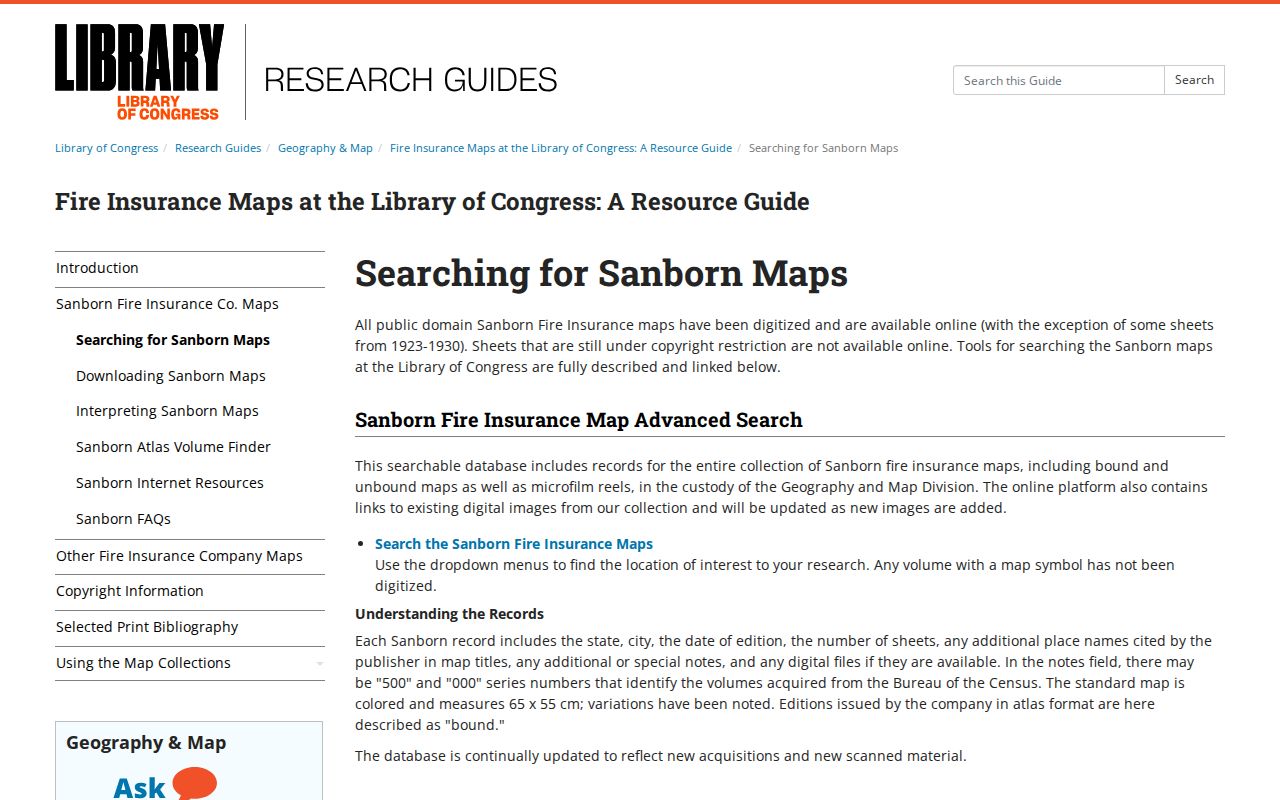
The Porterville Sanborn guide image is a research aid for the map layer. It supports Porterville building and street history, while the city directory supplies names and addresses from selected years.
Porterville Library Research Room
The Hillman Family Library of Local History and Genealogy is at Tulare Public Library, 475 N. M Street, Tulare, with the published phone number (559) 685-4500. The room reports more than 7,000 genealogy volumes. Its Porterville collections include California material, census tools, surname files, city and phone directories, vertical files, newspaper microfilm, vital and cemetery indexes, limited Porterville Evening Recorder obituary copies, and in-library Ancestry access.
Call before traveling because the Porterville obituary run is limited and its exact dates are not published. Sequoia Genealogical Society volunteers organize Porterville material and answer research questions. Ask for a Porterville year, surname, address, organization, or newspaper date. A precise request helps staff distinguish a directory shelf search from a certificate request, a newspaper lookup, or an archive finding-aid check.
The room is the documented local access point for the Porterville city directory holdings. A state archive catalog, FamilySearch place search, NARA census collection, or newspaper repository can add a second channel, but each has its own coverage and image rules. Porterville library staff can help identify the shelf; a custodian still controls a certified record.
Obituaries, Yearbooks, and Archives
Porterville obituary research is regional. The Porterville genealogy room has limited Porterville Evening Recorder copies, while broader microfilm includes Tulare Advance-Register and Visalia Daily Delta or Morning Delta material for 1892 to 1928. An obituary can provide relatives, a service, a former address, or a burial clue. It is submitted by a family or publisher, so compare it with a certificate, interment record, deed, or probate filing.
Porterville College's community digitization of The Log yearbooks covers Porterville material from 1928 through 1971. College library access at 100 E. College Avenue can help verify student, faculty, club, or class references. Church, veterans, fraternal, chamber, alumni, and organization rosters are private unless voluntarily published or donated. Search the Porterville museum or library finding aids rather than assuming a current membership list exists.
The Jeff Edwards Archives are a local-history lead for photographs and subject files. Exact finding aids and fees were not online. Ask for a surname, street, organization, or time period, then record the archive's own description of what was found.
Limits of Porterville City Directories
A Porterville city directory is selective, historical, and publisher-specific. It may omit a household, place a nearby community in a Porterville volume, use a stale address, or treat one householder as the representative entry. It does not establish that a person still lives at the Porterville address, that everyone in the building was listed, or that a business address is a home.
Use the Porterville shelf for family history, reconnecting with a classmate, studying a Porterville street's past, or testing a name against a dated source. For a modern Porterville address chain, preserve the APN and legal description and then use the county property, GIS, and Recorder systems. For one person's current record trail, move to a source that states its own access rule.
Reading rule. “Not listed” means only that the selected volume did not yield an entry under its own coverage and indexing rules.
Note: Directory years, locality headings, publisher keys, and gaps should accompany every historical name citation.